Healthy because the person who is over committed or overwhelmed actually realized they can’t do everything alone and they had the courage to ask for help. Being able to ask for help is a huge step for those who have always shouldered burdens alone.
Healthy for the potential helper because they are aware that help is only real help when you clearly define what the person is asking for before you start to do the work with their permission.
Helping is hearing what the other person would be doing if they could clone themselves to do multiple tasks simultaneously and then doing those things for them with no deviations.
They had the original vision. They have a plan. They have a schedule and an order in which things need to happen and they are asking because they need assistance to complete the steps to the finish.
They do not need you to reimagine the job at hand. They do not need you to ignore the procedure or the materials or the instructions while you take over and change things to your own specifications.
That is not offering help. That is taking control.
Now let’s be clear. If a person is asking for help and they do not know what the next steps are, they will say something to the effect of, “ I don’t know how to do this part.”
That is your opening to ask if it’s ok if you come up with a solution for the next step. That would be a clear ask where the planner would willingly relinquish control of that part of the larger plan to you, the helper.
But if they do have a plan and they just don’t have the time or enough hands to get it done, then any deviation from their plan to suit your own interpretation is not help. It is taking control.
When you take control without explicit permission, you are removing the other persons autonomy. You have removed their discretion, their freedom and their decision making by assuming that your way is the superior way and must be forced into implementation.
Example: Your husband goes through boxes of old clothing that you haven’t seen in a while. You had planned to go through them and make decisions about what should be kept, what should be thrown, sold or donated. Or what should be repurposed for its fabric or buttons, etc. The wife goes looking for the box. She has a need for an item she knows was in it only to find out that her husband had thrown the box into the trash and it’s now in a landfill somewhere.
He “thought” he was helping. He thought the basement needed to be cleared right now instead of staying with their original plan to process items in the spring during garage sale season. He had his own plan that he did not share wth his wife and he did not ask permission to dispose of her belongings.
This is not help. That is control. That is also a serious violation of privacy.
It’s bad enough when this happens once. But when the removal of someone’s autonomy in decision making has happened multiple times then you have set a precedent about whether you can be trusted around other people’s belongings.You have also demonstrated that you have no respect for the other person or their property.
As we enter the holiday season and our families and friends begin to plan multifaceted gatherings you will ether be a planner or a potential helper.
This isn’t the time to play junior therapist and psychoanalyze the planner’s perfectionist kink. There are things to do on a time schedule and piling on your compulsion to “fix” the planner while also controlling their autonomy is a recipe for disaster.
To the planner; be clear and realistic about what needs to be done to pull off the perfect day. Go old school and grab a pencil (they have erasers!) and paper and write down all the steps it will take to get from A to *collapse on the sofa after a job well done.* Note that you are one person and asking for help is not a character flaw. It’s a leadership skill.
To the helper; when you notice the planner appears frazzled and sounding more like a screech owl than a human take a moment to put your self in true help mode and not control mode. Then, ask the questions. Here they are again.
Do you want help, company or space?
How can I help you?
And now helper, here is the most important part. Really listen to the answers to those questions. Take every ounce of your self control and squash the part of you that is rising up from the depths of hell to release your control demon…again.
Simply follow the lead the planner gives you and all will be right with the world. Even if you think you know better. Even if it’s really, really hard to wrestle your impulses into submission.
Unless you don’t mind ending up with a Christmas tree shoved up where the sun doesn’t shine. Then, by all means, let your control demon loose to play. But be prepared to be on the receiving end of a retaliation that may leave your ego shredded and in the fetal position.
This bears repeating. Helping is hearing what the other person would be doing if they could clone themselves to do multiple tasks simultaneously and then doing those things for them with no deviations.
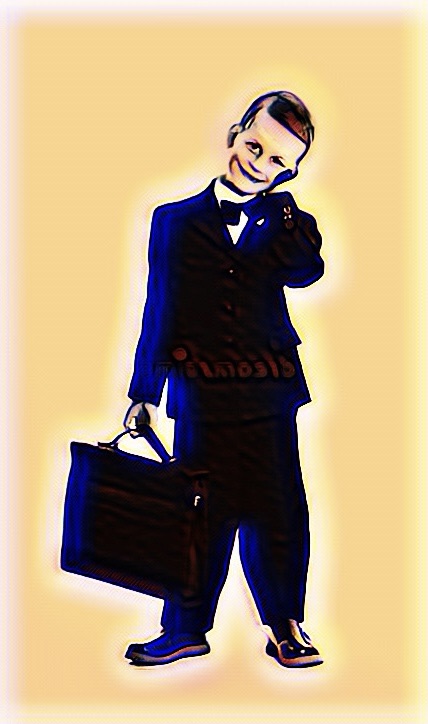
Little man. We often hear this affectionate term used for male toddlers and very young boys and along with this moniker is an adorable vision of the boy in a suit with a tiny brief case headed out to work to provide for and protect the family.
“You’re the man of the house today”. Or man of the house now, if the adult male is no longer present.
Never once in my youth did I hear, “you’re the woman of the house today”, even if I was left in-charge of my younger sibling and tasked with cleaning or cooking or some other adult housekeeping chore.
Right from the start, we begin to condition males to believe that they are the only viable in- charge person in a place where any females are present. The message is clear, you are the final word because you are a male.
It also brings to our attention that in placing the “woman” title on a very young female, we are dancing close to suggesting that the female is of “breeding” age and ripe for the picking by any male, any age; including presidents who felt entitled to shop for sex on islands owned by equally shady friends.
Since the same charming/adorable vision doesn’t happen when the term Little Woman is used, the phrase becomes an insult to females that is intended to place males in a power position.
The next time we hear an adult refer to a male toddler or young boy as “ little man”, how about pointing out the disparity of that language and that we should always be aware of how we address children.
It’s a small thing to be conscious of. A little moment. But it’s also the opening salvo of a lifetime of patriarchal dominance and abuse that could be smothered out now. Long before another generation of males reach puberty with the horribly wrong notion that females are on this planet to be little more than maids, cooks, baby incubators and sperm toilets.
You want to see me? You want to know me? You’ll have to visit in the evening When it’s soft and quiet And the song of crickets Makes my petals … Continue reading Poetry Day: Night Bloomer
Lao Tzu said long ago that the emptiness is what makes the cup useful. We spend most of our lives filling our cup with so many things; money, belongings, experiences, … Continue reading Emptying My Cup
Even if your world is not picture perfect, you can still carve out moments of small joys each day and take a few moments to honor their beauty.
En-joy: The prefix en- (often em- before is a word-forming element originating from Latin in- and Greek en-, meaning “in,” “into,” “within,” or “to cause to be/make into”. It transforms nouns and adjectives into transitive verbs, indicating covering, enclosing, or placing something into a state.
Being in a state of joy 24/7 is not sustainable. When complete joy is never ending, it morphs into the mundane and we either must find greater; bigger and bigger moments of that new high, or we must surrender to “less” and possibly suffer depression from the loss of the high.
In a world of sound bites and ads and teasers and memes, we are bombarded with things that marketing and PR have chosen in hopes of getting a reaction from us. Things that should shock or thrill, disgust or inspire us flash past our view a hundred times a day. So often that the visuals normalize and fade into the brain file labeled *mundane data*.
It takes something new, unusual and memorable to grab our attention now. And the link between the new and our attention is emotion. Marie Kondo got one thing right; it must spark joy.
Instead of attempting to make joy perpetual, try moving through many daily moments of small joys. We are then able to experience and collect snapshots, memory photos of them all and they fill our story in a very satisfying way.
Having personal time with those we love when we have their full attention and eye contact are small joy moments. It’s then that we know we are fully loved and seen and heard.
Our loved ones cannot be with us that way all the time as they need to fully live their own lives, as well, but they can be there fully present in small doses daily, weekly etc, fully satisfying our needs while we do the same for them.
These moments are what leads to true intimacy in relationships and allow the stage to be set for physical intimacy in romantic relationships. .
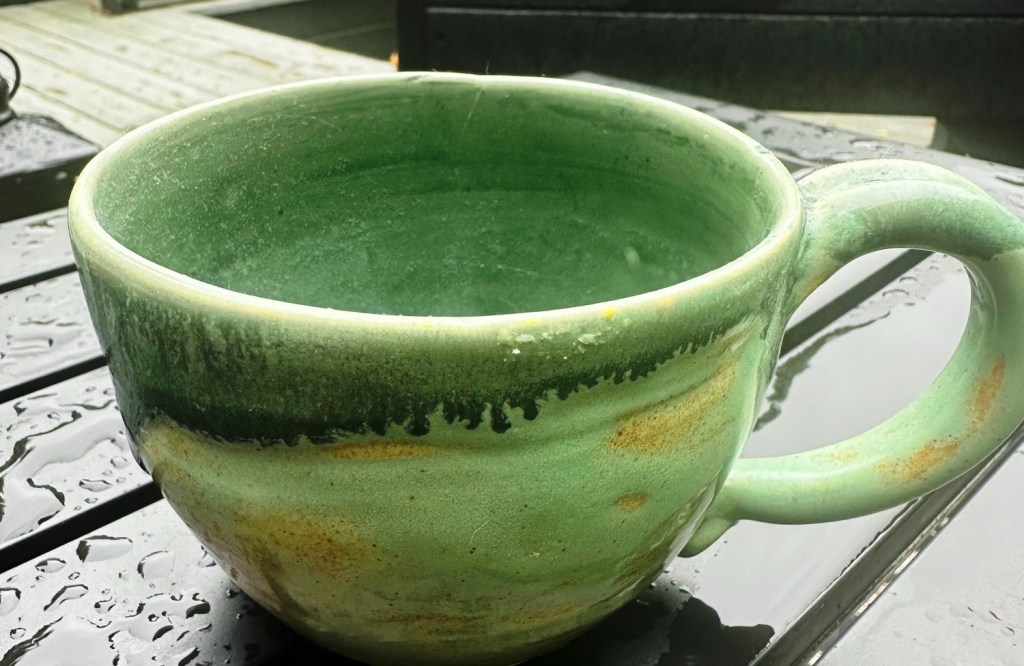
Things of beauty, like art, are small ways that we honor joyful spaces. A carefully chosen painting or a piece of pottery causes us to pause and give a moment of reverence honoring the creator of the piece. Even holding still in the wonder of the creative process that inspired a person to have made this in the first place. Brought forth from the void, we can see their vision with our own eyes.
The human form has its own beauty without any adornment at all. It does not stop a loved one from gifting us a pair of beautiful earrings that the giver can see, knowing that they have left their mark on us in this small way. A claiming and a celebration of their affection. The jewelry stands as a placeholder or symbol of love and when our fingers stray to trace the metal or when our laughter causes the bauble to swing and tap our neck, it’s a brief connection, a whispered reminder that we are loved. A collected moment of joy.
Rather than chasing the improbability of being happy “once and for all”, we can view these small moments of joy as scenic overlooks on the road of life.
The road will be long and sometimes difficult or even boring, but when the sign says “picture stop ahead”, we are gifted with an inhale of hope mixed with the opening notes of joy that this picture stop will make our day.
Go. Find something beautiful today and take a mental picture of it for your joy collection.
Your memory lives like thunder from a distant storm- the sound rattling my windows shouting still here still here still here and though I can not feel the rain and … Continue reading Distant Storm
If you can only love me when I finally become the imagined perfect version of me that you created in your mind,
then you clearly do not love ME.
I am not who you are campaigning for me to be
I was
I am and
I always will be me
With all my flaws, fears, coping mechanisms
With all my gifts and wisdom and talents
With all my awkward attempts at speaking my love languages to you
If you decide to stop withholding your love, even if I never change into the character you fantasize me to be,
you will find that I am here
I have always been here
In all my bold and ridiculous glory
With all my genius idiocy
Still holding on to all the acres of room I have carved out for you in my heart where I revel in the beauty of watching you run free and wild in your life as I cheer from the sidelines
One day, when I am long gone from this world, you may sit quietly with the small box you have tried to put me into and wonder what we could have had if you had given me the same courtesy to let me run free in my life too